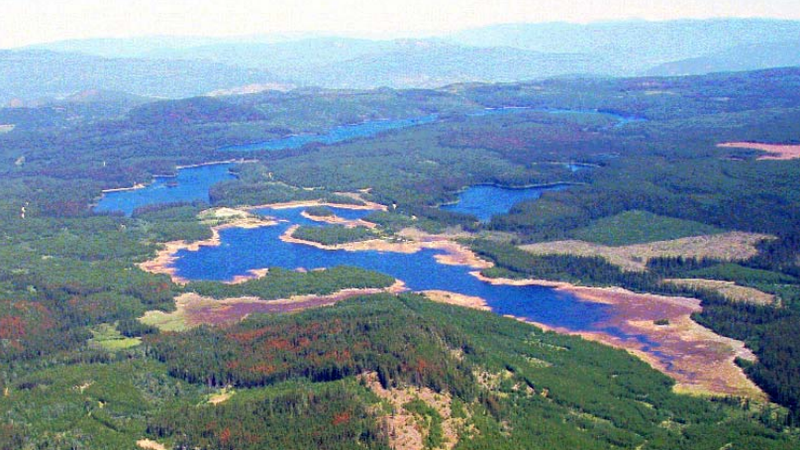
The Duteau watershed (stock photo courtesy of the RDNO)
Water Capacity Issues
Over a dozen concerns raised about local water capacity
May 23, 2025 | 9:37 AM
-
Share on Facebook
-
Share on Bluesky
-
Share on X
- Copy Link
Greater Vernon Water has several issues and concerns that need addressing.
Upon reviewing the utility (GVW) and its held water licences (WL), Regional District of North Okanagan staff compiled a report to the Board of Directors that outlined the 13 key issues.
- Operational and environmental flow needs: not accounted for in the GVW Master Water Plan, and reduces the amount of storage available in the Duteau Creek Reservoirs by 7,191 ML (mega Litres, or million litres) per year.
- Accessible water versus inaccessible water: GVW has infrastructure to access 52 per cent of total licensed volumes, with that to increase to 63 per cent once the Canoe Bay Pump Station is built, though significant infrastructure upgrades at considerable costs were required to access the remaining 37 per cent.
- Water licence type: GVW holds licences as both irrigation and waterworks, meaning water that can be accessed when the Aberdeen Dam is raised is designated for irrigation only, even though domestic customers will bear the costs. It was recommended that licence designations be changed to not put the financial burden for irrigation on domestic properties.
- Aberdeen dam raise to fully access Duteau Creek water licences: Raising the dam does not guarantee the reservoirs will be filled, as it is dependent on freshet, which is variable depending on the snow melt each spring.
- Extension of Gold Paradise diversion to fill Aberdeen Dam: Recommends GVW apply for an extension to assist with filling a raised Aberdeen Dam, though that could provide difficulties in obtaining approval.
- Transfer of remaining BX Creek water licenses to Okanagan Lake: GVW has 5,485 ML of licenses that still need to be transferred to Okanagan Lake, and GVW will be required to identify how they will access this water. It was also noted that the water would be expensive and there would be a need for pump stations at either end of a very long transmission main or a localized treatment facility.
- Use of Antwerp shallow well: Water from Antwerp wells will only be available in a non-potable system when the separated distribution is constructed nearby.
- Legislative changes: “Beneficial Use” clause in the Water Sustainability Act requires proof of a beneficial use, which must be determined for BX Creek water licences.
- Water Reserve: Discussions between provincial and RDNO staff have indicated the water reserve will not be granted, which had been identified as a need in the Master Water Plan.
- Climate change impacts: The impacts of climate change on water supply have not been assessed, but predictions show it will at the minimum have significant impacts to water supply and storage.
- Changes in water use trends: Water use trends have changed since the last technical analysis was completed in 2011.
- Unregulated industrial, commercial and institutional water use: GVW does not currently have a bylaw or process to regulate the amount of water used by these types of properties, which could put a strain on infrastructure and water capacity in the future.
- Water quality risks from highly aged water: Aged water created from long pipe mains to low density areas with low water flow could negatively impact water quality, leading to increased operations and capital costs to combat issues such as the creation of disinfection byproducts and low chlorine residuals.
To address some of these concerns, the staff report included recommendations to (3) change licence designations to not put the financial burden for irrigation on domestic properties; (10) undertake studies to better understand the impacts of climate change on water supply and storage; and (11) analyze water use trends in relation to agriculture and the Duteau Creek water treatment plant.