Get the Top, Local stories delivered to your inbox! Click here to join the daily Vernon Matters newsletter.
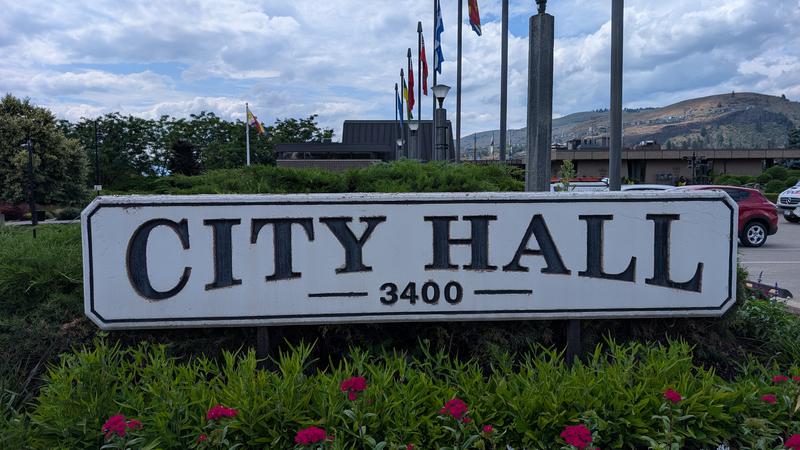
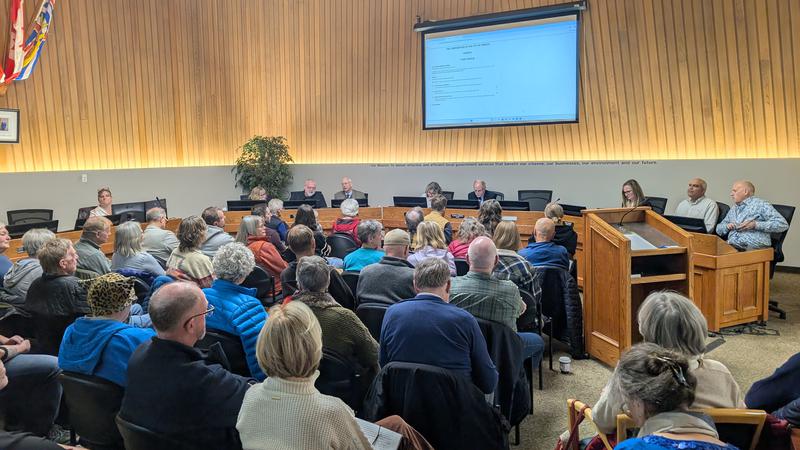
People filling the city council chambers for the Official Community Plan Public Hearing Monday evening (photo by Liam Verster / Vernon Matters)
OCP Public Hearing

‘Infill, not sprawl,’ the main message at Vernon’s OCP hearing

Nov 24, 2025 | 10:03 PM

Vernon’s Official Community Plan received some pushback regarding a clause that could allow sprawling developments up on hillsides.

The city held a Public Hearing for the Official Community Plan (OCP) Monday, Nov. 25, which saw around 70 people attend council chambers, 20 of whom spoke before council.

Of those individuals, 13 expressed concern with a clause that would allow more sprawling development on the hillsides.

4.1.5.3 – Only consider new Hillside Neighbourhoods that provide a significant tangible public benefit that includes wildfire mitigation, and most of the following:

Purpose-built rental, affordable, attainable, or special needs housing

Commercial and daily services such as daycares, food stores, or personal services

Conservation and restoration of environmentally sensitive areas

Dedication of parkland to the City

Improved or expanded community water and sewer or transit infrastructure

Improved or expanded neighbourhood emergency egress infrastructure

Proven financial viability of long-term lifecycle costs of infrastructure

Alignment with Official Community Plan objectives noted in Chapters 4 and 5

The concerns ranged from the fact that it went against the OCP’s stated goals of infill and densification; that they would not lead to more affordable housing being built; that it would lead to projects that disrupted or destroyed the environment; that the public transportation system would not be able to handle these developments; and that they would create more traffic issues for residents.

Other concerns raised at the OCP Public Hearing were that the document put the onus of FireSmart work on property owners; that there could be some instances where people could be allowed to build on environmentally sensitive lands; that there was no committment for Vernon to promote construction with higher levels of the B.C. Energy Step Code; and that wording regarding building heights might deter developers from building in Vernon. Another attendee also proposed Vernon consider ways to harness rain water for public use.

After receiving the public input, the regular city council meeting resumed, where the issues raised were discussed.

The first topic to be brought forward was the hillside sprawl concern, though city staff said the OCP would have no power to regulate those types of projects.

“The OCP is not a regulatory document. It’s not the rules of the land, it is a vision and a future state of how we want the city to be,” Terry Barton, Vernon’s Director of Planning and Community Services, stated.

“Many of the topics that we heard today are great comments, and we need all of the city’s plans, bylaws and policies to be rewritten and all growing in the same direction and be consistent, and it takes many, many policies, bylaws, regulatory rules and regulations, all the way down to their details, to ensure all these things have continuity.

“[Trisa Atwood, Vernon’s Manager of Community Planning and Sustainability,] spoke about the clauses in the zoning bylaw, the servicing bylaw, [during her OCP presentation during the Public Hearing]. These are the actual rules and regulations on the ground the developers have to focus.”

Barton added the OCP should be seen more as an “inspirational document” that guides how the city should be in the future, and that the regulatory pieces have to be adjusted in the coming year or two to make that vision become a reality.

The discussion did not lead to any changes of the hillside neighbourhood clause, though council did then speak about another matter that did see a change.

Councillor Brian Quiring and Mayor Victor Cumming both brought forward concerns with building height requirements.

Quiring had issue with limiting a building to being just 12 storeys maximum in the areas where the city wanted to see infill and densification, while Cumming was opposed to another clause saying residential buildings could go up to six storeys high in areas outside the core infill locations.

Following a lengthy discussion, and hearing from Barton that these would be attune to a change in “form,” those clauses could be changed.

Council voted to remove clause 5.2.2.1 from the building heights section of the document, and then tasked staff with investigating zoning bylaw amendments that could be brought back to council and later incorporated into the OCP.

That clause went as followed:

5.2.2.1 Consider buildings ranging from 6 to 12 storeys when located within 100m of major streets, transit corridors, transit stops, parks, or multi-use paths, where they support transit use, enhance the public realm, and transition sensitively to adjacent lower density areas.

The following clause that Cumming had issue with was also amended to remove the reference to the aforementioned clause.

5.2.2.2 [In accordance with Police 5.2.2.1], generally discourage buildings greater than 6 storeys that are not within 100m of major streets, transit corridors, transit stops, parks, or multi-use paths, to support a sensitive height transition.

Council voted in favour of those amendments, with only Councillor Kari Gares voting in opposition due to it not being an issue that was brought forward during the public hearing and could have been amended earlier in the document drafting process.

Council also voted unanimously to remove a Boundary Extensions clause, noting it could lead to less interest to developers and that an annexed property could cover a multi-acre piece of land. That clause read as follows:

4.1.5.4 Explore the development of a municipal boundary adjustment protocol agreement that creates certainty for all parties when reviewing annexation applications, including the potential for shared service agreements. These processes will be City-led in collaboration with the Regional District of North Okanagan and will only be contemplated where the incorporation or servicing of developable lands could provide a public benefit. Boundary extensions initiated by property owners for single properties will not be supported.”

After making the amendments, council gave third and final reading of the OCP Monday evening.

The document will be brought forward for adoption at the regular meeting on December 15.

View Comments