Get the Top, Local stories delivered to your inbox! Click here to join the daily Vernon Matters newsletter.
(File photo/Vernon Matters Staff)
drought year expected

New triggers for water restrictions for Greater Vernon

Mar 6, 2024 | 5:00 AM

Water customers in Greater Vernon can expect to see changes to water restrictions this year in what is expected to be a drought year.

After the drought in 2023, Greater Vernon Water (GVW) staff determined there were a number of operational conditions that were not fully considered in the development of the Duteau Creek Water Storage Triggers Graph (DCWSTG), which dictates the stages of water restrictions (normal to stage four).

That led to a staff review of the storage levels, the restrictions and triggers, followed by an update to the graph based on water conservation goals of each stage of the restrictions.
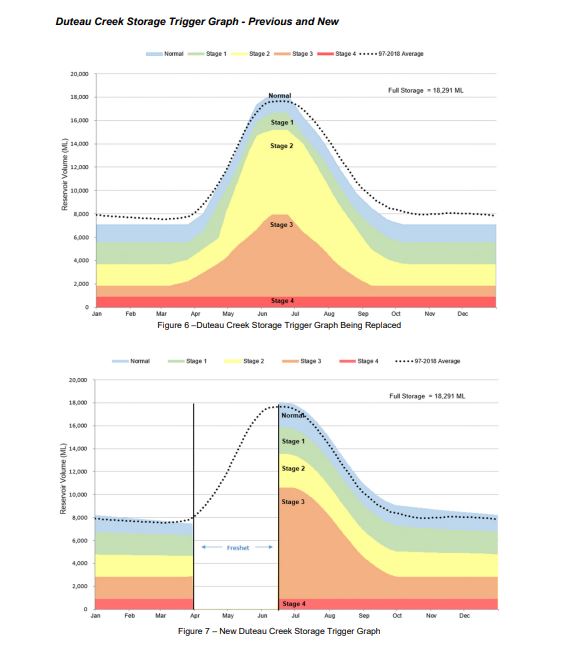
Duteau Creek storage trigger graph (previous at top and new on bottom) (RDNO image)

A report from the Regional District of North Okanagan’s Utilities Department (Greater Vernon Water) to the Greater Vernon Advisory Committee (GVAC) said the changes will ensure longer term sustainability of the infrastructure.

“The revision is slightly more conservative but provides a larger contingency during drought years and will assist the utility’s response during water supply shortages and protect infrastructure,” the report stated.

Staff say while historical data is useful in assessing water storage and shortages, there are limitations to only using that data to inform water shortages.

“Current triggers are based on previous years’ averages and trends, but we’re heading into new territory with earlier freshets, lighter snowpack and multiple years of drought impacting soil conditions.”

Between 60 and 70 per cent of the water distributed to customers in Greater Vernon comes from the Duteau Creek system.

The updated Duteau Creek Water Storage Triggers Graph (DCWSTG) includes:

  • changing the stage calculation from statistical analysis to predicted water needs and conservation goals reflective of GVW water restrictions,
  • incorporating operational water needs in the fall and winter with water level reservoir goals and minimum levels required to protect the infrastructure,
  • incorporating higher fall flow needs of the EFN targets negotiated in 2016, and
  • eliminating stage requirements from the freshet period. Stage restrictions during this period are more subjective and linked to the rate of snow melt and weather. (It should be noted that the WSMP is flexible enough with the Triggers that are monitored to detect if drought occurs within this “freshet” period and for staff to respond accordingly.)

Typically Greater Vernon Water staff don’t start to inform the board and public of the water supply conditions until April or May; however, due to the continued provincial drought conditions and unusual weather patterns of the fall and winter, staff are preparing for a potential drought.

“Although the severity of drought and the corresponding restrictions can’t be determined until after freshet, prior stakeholder consultation has indicated that they would appreciate prior notification of risk of drought if possible,” the report said.

Staff monitor four triggers to assess the water supply and drought conditions:

1. Reservoir levels (water storage)

  • Duteau reservoir – Duteau storage is below average and within the Stage 1 restrictions zone. Stage 1 EFN [environmental flow needs] flows and operational measures are currently being used to maintain storage levels and weather and freshet will be pivotal to determine the impact of staged restrictions during the irrigation season.
  • Kalamalka Lake – January 2024: Kalamalka Lake levels were below the average and provincial targets; however, recent levels have begun to increase due to precipitation in the area.

2. Current moisture conditions – The February snowpack measurements indicate a snow pack of 81 per cent of normal in the South Thompson Basin (Duteau source) and 86 per cent of normal in the Okanagan Basin (Kal source).

3. Forecast weather conditions – based on the federal forecast, these continue to indicate above normal temperatures from February to April with below normal precipitation, which could negatively impact water supply.

4. Customer demand forecast – Customer demand for February has been typical for this time of year and reflects indoor water use.

The current water supply is at a Stage 1 based on the February water storage levels and the forecasted moisture and weather predictions for March and April.

“As there is currently no outdoor watering or agricultural irrigation at this time and as freshet has not yet occurred, this Stage 1 mainly impacts operations and the variable EFN [environmental flow needs] requirements for Duteau Creek,” the report explained. “Operations has been actively conserving water in the Deteau storage reservoirs since the fall by optimizing the use of Kalamalka Lake, drastically reducing operational flushing and preparing backup wells.”

The utilities department report will be discussed at GVAC’s meeting Wednesday, March 6.

View Comments