Get the Top, Local stories delivered to your inbox! Click here to join the daily Vernon Matters newsletter.
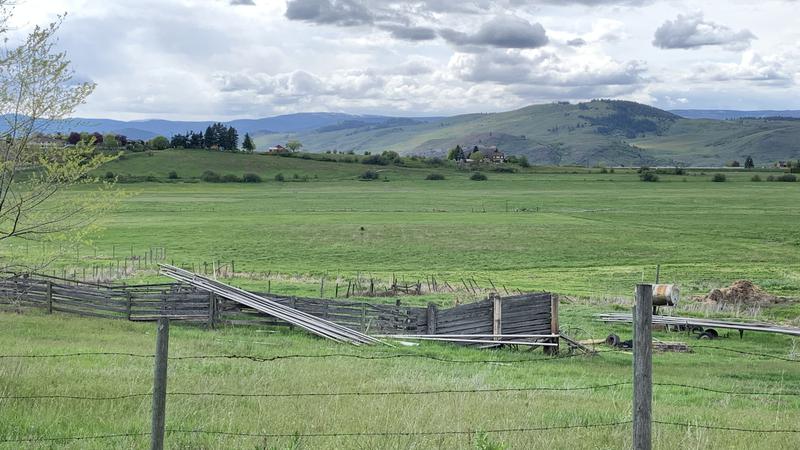
BX Ranchlands (photo by Liam Verster / Vernon Matters)
137 acres

Big plans proposed for BX Ranchlands

May 12, 2022 | 4:12 PM

The Regional District of North Okanagan (RDNO) has drafted a proposed plan for the BX Ranchlands.

The proposed design for the 137 acre property on East Vernon Rd. sections off 90 acres for farm land leases; 24 acres for habitat protection; 12 acres for a research and teaching farm; five acres for a community farm; two acres for pollinator meadows; one acre for a community garden; and half an acre for a food forest.

The RDNO has an application in to the Agriculture Land Commission requesting converting some of the agricultural land along the border of the property to complete the walking trail route.
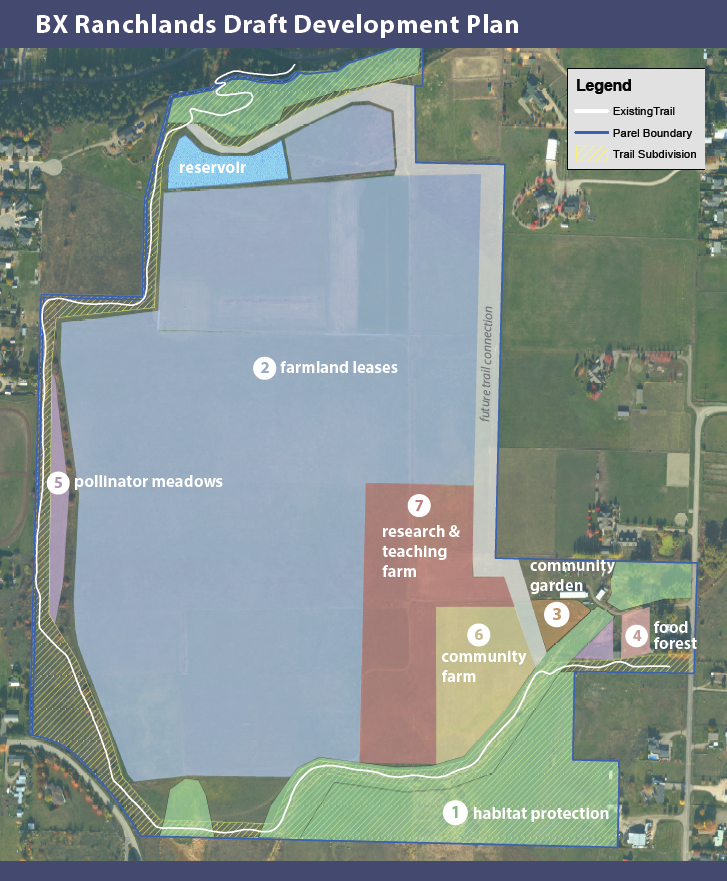
The proposed plan for the BX Ranchlands (image courtesy of the Regional District of North Okanagan)
The plan was designed in collaboration with the Institute for Sustainable Food Systems (ISFS) and the Land to Table Network of the North Okanagan (L2T). The ISFS is operated through the Kwantlen Polytechnic University (KPU).

Jenn Cline, a Research Associate with the ISFS, told Vernon Matters the proposed plan and all the components involved meet some key visions for the site.

“[Key visions include] ecological stewardship, land access for farmers and spaces for food growing, and working with the vision for decolonization and reconciliation with First nations groups, and community and larger regional area education around food and land stewardship,” said Cline.

The plan includes seven activity areas with the biggest allocation for farmland leasing. It has not been determined if the land will be divided up an leased off to several users or if farmers will be able to request specific lot sizes.

It’s also unknown as of time of publication if there will be requirements for what is grown on the site, but RDNO Area B Director Bob Fleming told Vernon Matters the land had previously been used to grow hay, and would likely be used for that purpose again in the future

Though what is grown or by whom is unknown at this time, Cline did say there could be requirements on how it’s grown.

“We’re recommending that the site is run organically,” said Cline.

“There’s opportunities to get certified organic status as a group with multiple farmers, so we’re recommending that [the farms be] chemical free. Of course there’s some invasive [species] we need to keep control of, but we’re recommending that it’s a spray free zone.”

The plan sets aside 24 acres for habitat protection, which includes cattail wetlands, graminoid wetland, Hog’s Gulch, a douglas fir forest, and a badger den.

The plan recommends using 12 acres for a research and teaching farm, allowing for more educational opportunities that is specific to the region’s farming.

“The [research and teaching farm] would bring in post-secondary students in for training and aspects of agriculture that’s sort of for this area,” stated Fleming.

“[ISFS and] KPU is centered down at the coast, but agriculture at the coast is significantly different than agriculture here, so being able to train people in agriculture in an area like this where they get to find out about different growing conditions that we have I think is an interesting opportunity.”

It was also noted that the use of the research land could have varied uses.

“With the Institute for Sustainable Food Systems, we actually have a couple of farm schools, and we’re really passionate about education to farmers, to new growers, to folks who have been growing for a while, and also really focusing on strengthening regional food systems,” said Cline.

“The thought was that the research farm could have multiple functions, there could be collaborations with the local universities here, with agricultural research projects, there could be crop trials as farmers are adapting to climate change and how that affects their crops.”

Cline added that the farm research area could also be used for community education.

It’s recommended that five acres be allocated as a community farm that can be run by a non-profit to feed people in need locally.

The proposed plan also sets aside space for 40 community raised-garden spots, and half an acre for a food forest.

“[Food forests] are rooted in Indigenous methods of cultivation and designed around the aim of encouraging the growth of plants, medicines and materials,” said Cline.

“The idea is that it’s a forest, so there’s different layers. There’s a lot of perennials involved. There’s some canopy layers of trees, and then shrubs, but also an integration of annual plants for foods. So the idea is that you build a forest environment that can kind of become self-sustainable and is a place for folks to engage, to harvest food and medicine from, and to learn about stewarding an ecosystem and not just growing some food.”

Cline also noted the proposed pollinator meadows could be co-managed by the RDNO’s Parks Department and some non-profit organizations with site caretakers ensuring weeds do not spread to the adjacent farms. She added they received some freed back from neighbours expressing concerns over weeds, and are now making recommendations for strong land management practices to ensure the meadow does not adversely affect other properties in the area.

The proposed plan for the property off East Vernon Rd. was released by the RDNO to provide the public with another opportunity to have their say on the use of the land. An online survey is open until May 16.

The feedback gathered will be used to tweak and adjust the plan, which is expected to be complete and presented to the RDNO for approval in the summer, though exact dates have yet to be set.

View Comments