Get the Top, Local stories delivered to your inbox! Click here to join the daily Vernon Matters newsletter.
(File photo/Vernon Matters)
proposed changes

Commission pitches plan for new Vernon-Lake Country federal riding

May 4, 2022 | 5:00 AM

A committee looking into reconfiguring the boundaries of British Columbia’s federal electoral districts is recommending a new riding be created between Vernon and Kelowna.

The Federal Electoral Boundaries Commission is proposing the new riding be called Vernon-Lake Country, using portions of the current North Okanagan-Shuswap and Kelowna-Lake Country districts.
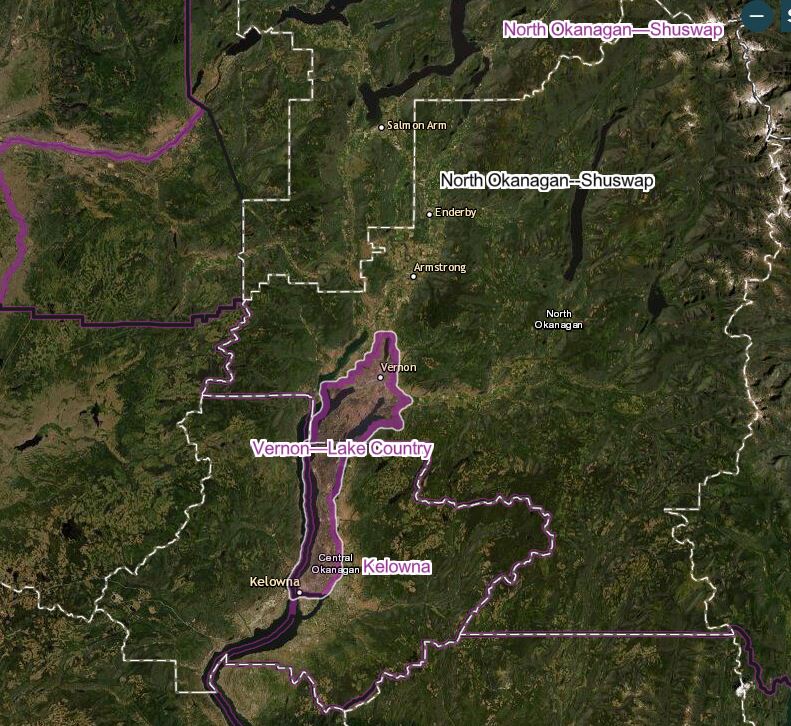
Map showing proposed new Vernon-Lake Country federal riding. (Image credit: FEBC)

The new riding would encompass most of Vernon (excluding parts east of L & A Road) part of Coldstream, parts of RDNO Areas B and C, Lake Country, and part of the Regional District of Central Okanagan. Click here for full description. It would not include Lavington, which is part of Coldstream, Lumby or Silver Star.

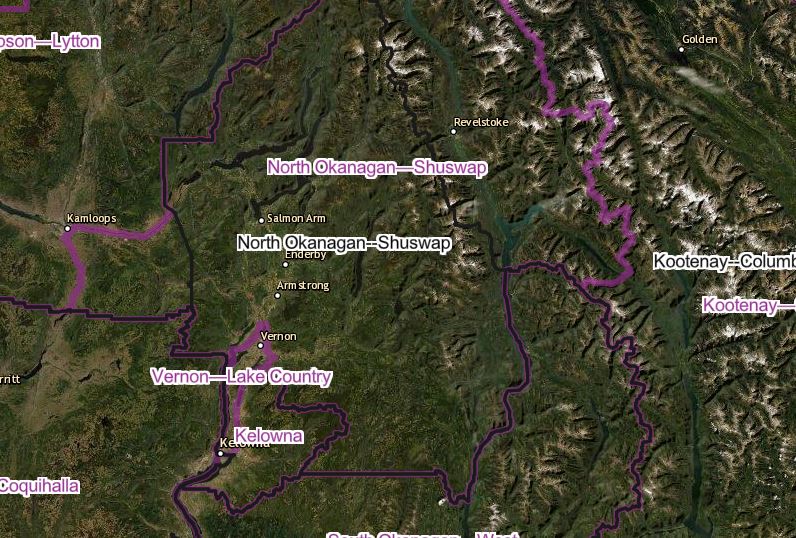
The current North Okanagan-Shuswap riding would keep that name and start north of Vernon, including Spallumcheen, Armstrong and Lumby. See the full description here.

North Okanagan Shuswap proposed boundary (Submitted image/FEBC)

Under the changes, Vernon-Lake Country would represent 111,205 residents and North Okanagan-Shuswap would have a population of 109,971.

With the proposed new riding, B.C. would have 43 electoral districts, an increase of one over the current allotment, which the commission says is needed to reflect population growth.

The commission will be holding meetings in 26 communities to get input on its proposed changes, including in Vernon at the Okanagan Regional Library on 30th Avenue on June 15 at 1:00 p.m. and in Kelowna, at the Best Western Plus on Tuesday, June 14 at 7:00 p.m.

A virtual hearing will wrap up the input sessions on Sept. 28 at 7:00 p.m.

The process of reconfiguring electoral district boundaries is required by the Canadian constitution and takes place every 10 years, after completion of the decennial census.

The 2021 census reported an increase of about 600,000 residents to B.C.’s population since 2011, to just over 5-million.

The commission said if there were 43 electoral districts, that would translate to about 116,300 people per district.

Click here to read more about the commission’s recommendations.

View Comments