Get the Top, Local stories delivered to your inbox! Click here to join the daily Vernon Matters newsletter.
Premier John Horgan at the announcement of the newly tabled Anti-Racism Data bill. (B.C. Government/Youtube)
Anti-Racism Data Act

B.C. to modify data collection standards to dismantle systemic racism

May 2, 2022 | 1:24 PM

The B.C. Government is pushing legislation to review and change how data is collected and used to eliminate systemic racism and discrimination.

The new Anti-Racism Data Act will see demographic data collected through government agencies.

The information will then be compared to program and services data to help identify any shortcomings and help shape the revision of policies or programs to resolve inequities and remove barriers for racialized or marginalized British Columbians face.
(Image credit: BC government)

The act is based on the input of more than 13,000 British Columbians. It was noted that 92 per cent of radicalized people involved in the consultations believe the collecting of intersectional demographic data, such as ethnic origin, ancestry, faith, ability and gender identity, could bring positive change in B.C.

“Our province is shaped by diversity with people from all over the world choosing to come to B.C. to build a better life. But for too long, systemic racism and the long-lasting effects of colonialism have unfairly held people back when it comes to education, job opportunities, housing and more,” said Premier John Horgan.

“These injustices are compounded when Indigenous Peoples and racialized communities ask for action only to be told by government to provide evidence using data that is not being collected. Today, we are taking an important step toward building a more equitable province by shining a light on barriers that exist so we can improve services and make life better for everyone.”

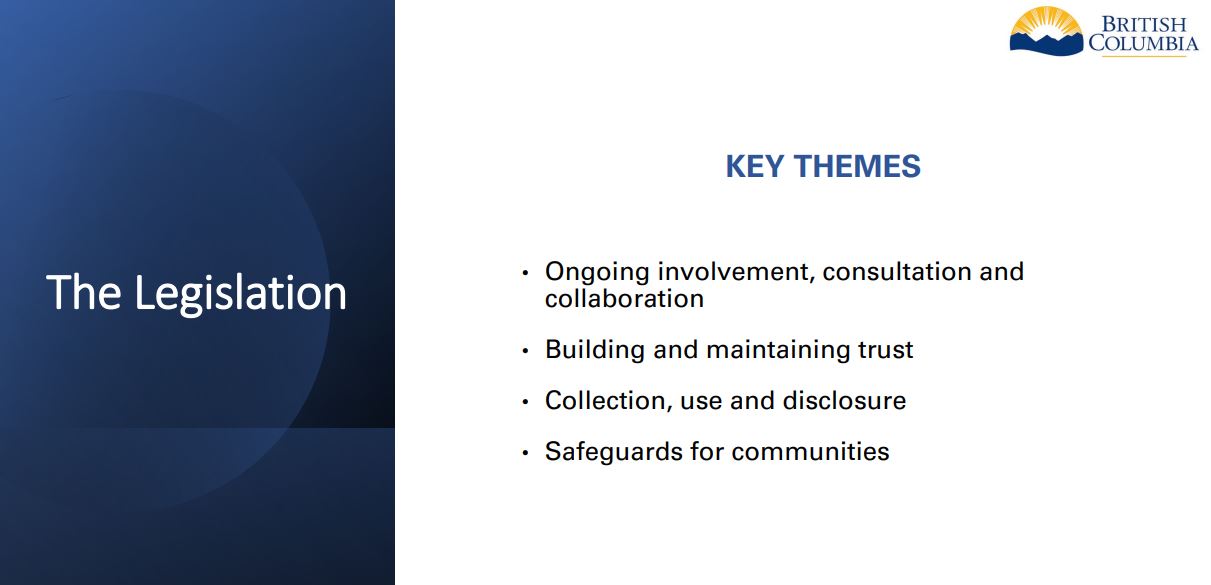
The key themes of the act include ongoing involvement and collaboration; building and maintaining trust; collection, use and disclosure of data; and safeguards for communities.

The act establishes data initiatives for collection standards involving identity variables; directives on how to collect and disclosure the information; research priorities such as key areas identified in specific sectors; and the annual release of statistics, including information from case studies and research reports.

(Image credit: BC government)

The act also calls for an anti-racism data committee to be established to advise on data management and collaborate on data initiatives. That committee would be appointed in August of 2022.

Following the creation of the committee, there will be a population survey conducted in November. The information from the survey will be used to compile data directives on intersectionality and cultural safety next May, which coincides with the first annual release of statistics.

The data standards would be reviewed again in November of 2023.

The act includes provisions starting that providing information is voluntary, that services will not be withheld or altered if the individual declines to provide information, and that personal information is collected directly or indirectly the public body must post a public notice.

The act also has a number of safeguards including enabling and protecting whistle-blowers, having an examiner appointed to investigate potential contraventions, to requiring a public body takes action on community harm, and for periodic reviews of the act with communities.

The legislation was developed with Indigenous peoples and other racialized communities, including the First Nations Leadership Council and Metis Nation B.C., the B.C. Assembly of First Nations, the Union of B.C. Indian Chiefs, and the Multicultural Advisory Council. The First Nations Leadership Council and Metis Nation B.C. also helped co-develop the policy and the draft legislation.

(Image credit: BC government)

The act is one of the first pieces of new legislation to be co-developed with Indigenous leadership under the Declaration on the Rights of Indigenous Peoples Act.

The Anti-Racism Data legislation builds off recommendations from the B.C. Human Rights Commissioner’s report, the Grandmother Perspective, which provides suggestions on how the government can use disaggregated data to address systemic discrimination.

View Comments