Get the Top, Local stories delivered to your inbox! Click here to join the daily Vernon Matters newsletter.
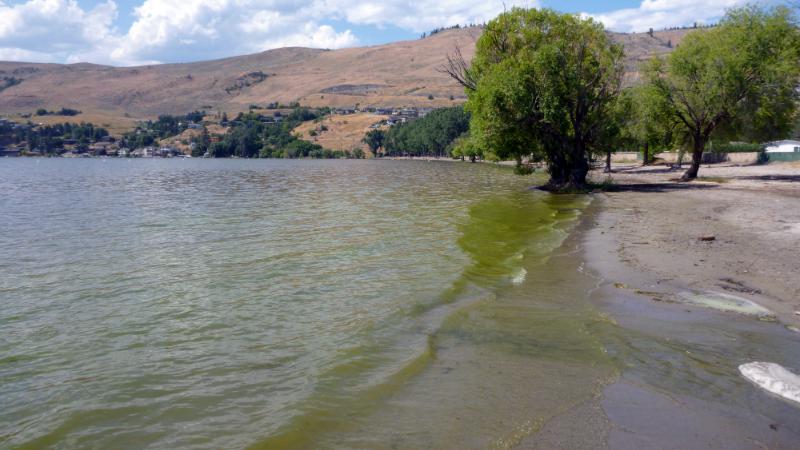
Algae on Sandy/Canoe Beach Okanagan Lake 2017 (Photo credit: Province of B.C.)
Blooms unattractive and sometimes toxic

New algae watch website launched by the province

May 12, 2021 | 12:24 PM

Algae blooms on area lakes are sometimes just an inconvenience, but they can also be toxic, so the provincial government has launched a new resource to help people identify and report issues.

Last fall, a large bloom on Kalamalka Lake forced Greater Vernon Water to switch drinking water sources.

A bloom in Wood Lake last month promoted officials to warn people to stay out of the water, and not use it for drinking or watering livestock.

Last July, a rare phenomenon occurred when a large algal bloom filled most of the Salmon Arm end of Shuswap Lake, turning the pristine water into pea soup for several weeks.


“We’ve never seen anything quite like that. We’re still trying to fully understand the cause,” Mike Sokal, a water quality limnologist (study of inland aquatic ecosystems) for B.C.’s Ministry of Environment and Climate Change Strategy said. “The lake was visually unappealing, but health officials noted the water was safe for all recreational activities and public drinking water systems.”

Ranging in size from microscopic single cells to large seaweeds, algae are a natural part of all aquatic ecosystems, providing food for fish and supplying much of the oxygen we breathe. However, prolific growth can cause a dense mass or bloom to form. Most of the blooms are harmless, according to Sokal, but some species have the potential to produce toxins that can be dangerous to people, pets or livestock.

To better understand where and when algae blooms happen around the province, the ministry has developed the educational Algae Watch website.

The website helps people recognize potentially harmful algae blooms and differentiate algae blooms from other natural phenomena, such as foam or pollen, which can sometimes look like blooms.

People can also use the online submission form to provide information on the location, extent and photos of an algae bloom, and access links to provincial health authorities in the event of a blue-green algae (cyanobacteria) bloom. The data collected will help scientists, like Sokal, determine future water-monitoring programs.

“The website can help us track changes over time and identify areas of the province that are getting more algae blooms. We can then start investigating what’s causing these changes,” Sokal said. “It’s really encouraging to see people interested in what’s happening at their lake.”

Anyone with immediate concerns related to drinking and/or recreational water use is asked to contact their local health authority. Health link B.C. also has a resource page.

Fifty-three B.C. lakes including Kalamalka, Mabel, Mara, Okanagan, Sugar, Swan and Wood Lakes are part of a B.C. Lake monitoring program.

View Comments