Get the Top, Local stories delivered to your inbox! Click here to join the daily Vernon Matters newsletter.
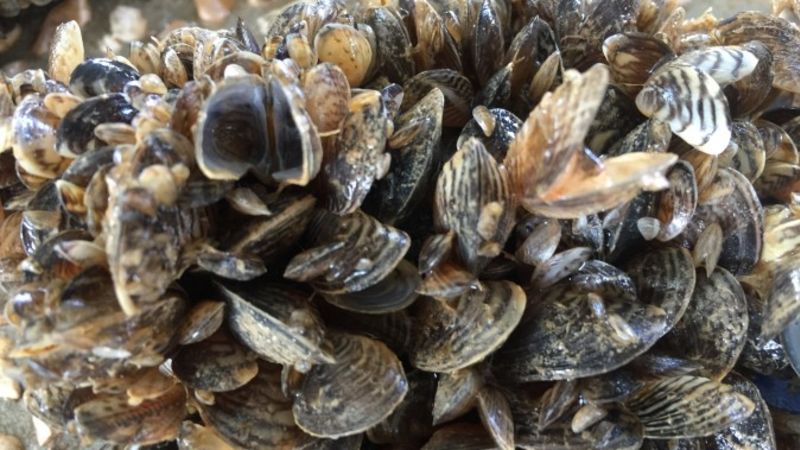
Asian clams (photo / Columbia Shuswap Invasive Species Society)
Different from invasive mussels

Invasive asian clams found in Shuswap not a priority

Feb 7, 2021 | 12:00 PM

The Okanagan Basin Water Board (OBWB) has been briefed on the province’s response to a request for action by the Shuswap Watershed Council.

A survey conducted by the Columbia Shuswap Regional District found concentrations of the mussels at Sunnybrae and Canoe beaches last year.

“At Sunnybrae we were finding around 20 clams per square metre of lake bed,” Sue Davies, Aquatic Coordinator for the Columbia Shuswap Invasive Species Society, said.

The Asian clam is an aquatic invasive species that is commonly less than 1.5 inches in size. Despite its small size, under the right conditions, the Asian clam can reproduce alone and spread throughout waterways rapidly.


The Asian clam is not to be confused with invasive zebra and quagga mussels which are not currently in B.C. and have been the focus of a massive effort to keep them out of waterways.

“The invasive mussels are a far greater risk to the ecosystem, economy and infrastructure than invasive clams,” James Littley, OBWB Operations and Grant Manager, said.

The clams were found in Washington state, as early as 1938, in the Columbia River; on the American side of Osoyoos Lake and in the Lower Mainland.

The province was asked why the infestation in Shuswap Lake didn’t trigger any provincial reaction.

“We were told they already exist in the province, there is no quarantine, no plan in place, and they didn’t think it was serious enough totrigger a response to eradicate or prevent the spread any further.” Littley said.

There are some notable differences betweenthe two species:

Invasive Clams

Invasive Mussels

Already in B.C.

Not introduced in B.C.

Hermaphroditic – 1 individual can start a population

Not hermaphroditic – need male and female to establish a population

1,000 – 100,000 eggs per clam/year

40,000 – 1,000,000 eggs per mussel/year

20,000/square meter

100,000/square meter

Filters ~ 1.3 litres/hr/clam

Filters ~1.15 litres/hr/mussel

Low tolerance for low temperatures = wide population swings

Higher tolerance for cold and for deeper water depths

Consumes phytoplankton from water and organic material from sediment

Only consumes from water column

Do not attatch to surfaces (burrow in the sand).

Accumulations can clog infrastructure and build up in irrigation ditches requiring dredging

Attach to almost any surface and leech calcium. Clog infrastructure completely.

Shell accumulation can impede recreation

Shells accumulation can impede recreation

“There is an assumption of limited harm. Nonetheless, it points to the need for more comprehensive planning for future AIS discoveries,” Littley added.

View Comments