
Get the Top, Local stories delivered to your inbox! Click here to join the daily Vernon Matters newsletter.
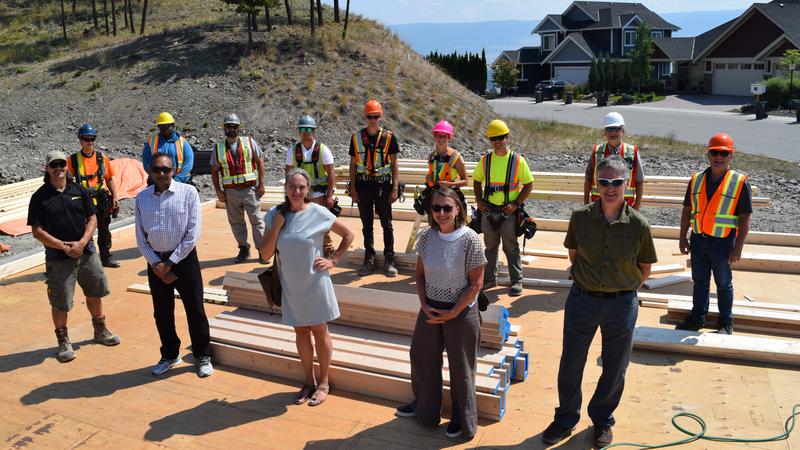
Project partners at the site of the Wilden Living Lab Phase 2 Home (L to R) (front row): Dom Caron, Authentech Homes; Dr. Shahria Alam, UBC School of Engineering, Karin Eger-Blenk, Wilden; Carol Suhan, Fortis BC; Dr. Andrew Hay, Okanagan College; (back row): Okanagan College carpentry students with instructor Tim Dorn (second from right) and Stephen Speers, Dean of Trades and Apprenticeship (right). (Submitted photo/Okanagan College)
Home of Tomorrow

Phase 2 of energy efficient home project underway

Aug 23, 2021 | 12:45 PM

Okanagan College and UBC Okanagan, in partnership with Wilden’s Blenk Development, AutheTech Homes and FortisBC, have entered Phase 2 of a project indented to create the most energy-efficient house possible.

Phase 1 of the Wilden Living Lab project saw the ‘Home of Tomorrow’ built in 2016 along with a regular-code home. Along with all the regular features, the energy-efficient home had increased insulation, triple pane windows, a geothermal heat pump, photovoltaic solar panels, water saving taps and toilets, net metering and LED lighting.

Over the course of three years, the two homes were studied, and in 2019 the comparative results showed the ‘Home of Tomorrow’ used 67 per cent less energy and had 99.6 per cent less carbon emissions than the standard home.

The partners in the program have now decided to move into Phase 2 of this project, and will look at ways to improve green homes for the future.

The first study, supported by the Natural Sciences and Engineering Research Council of Canada, was led by UBCO’s Dr. Shahria Alam, who has been lead researcher on the Wilden Living Lab since its inception.

“Phase 2 will be really exciting. If we achieve our goal, we’ll be able to share findings that will help other households achieve net-zero status using the optimal combination of materials, systems and construction practices,” said Alam.

“As our region, the country and the world look to tackle climate change, building more efficient, sustainable and affordable residential housing will go a long way to helping us all do our part.”

Partners in this project will collaborate on the design, construction and research of an Energy Step Code 5 sustainable home, which is the highest level in British Columbia’s Optional Energy Step Code.

The home will target net-zero energy usage through solar panels, renewable natural gas and other ultra-high efficiency technology and building materials.

The project will see carpentry students from Okanagan College help build the homes as they did in Phase 1 of the project. This will provide the students with real-world experience and help them learn about opportunities for the future of building.

“The Wilden Living Lab has created fantastic learning opportunities for our students,” said Dr. Andrew Hay, Provost and Vice-president academic for Okanagan College.

“It’s hands-on learning in a real-world environment. For the students to be involved in seeing how these new energy-saving technologies are installed, and to play a role in that, sets them up for a future that will benefit all of us.”

The project is part of a larger collaboration in green building between Okanagan College and UBCO through the joint Green Construction research Training Centre, which aims to provide new research options, create hands-on practical training opportunities, and be a hub for innovation in green construction.

The Wilden Living Labs project has also received a $112,500 grant from Mitacs, the national non-profit research and training organization dedicated to advancing collaborations between industry, academia and the government of Canada.

Construction of the Phase 2 ‘Home of Tomorrow’ is underway, and the findings of a comparison study involving this house and another standard house will be published for those looking to create green houses and buildings in the future.

View Comments