Get the Top, Local stories delivered to your inbox! Click here to join the daily Vernon Matters newsletter.
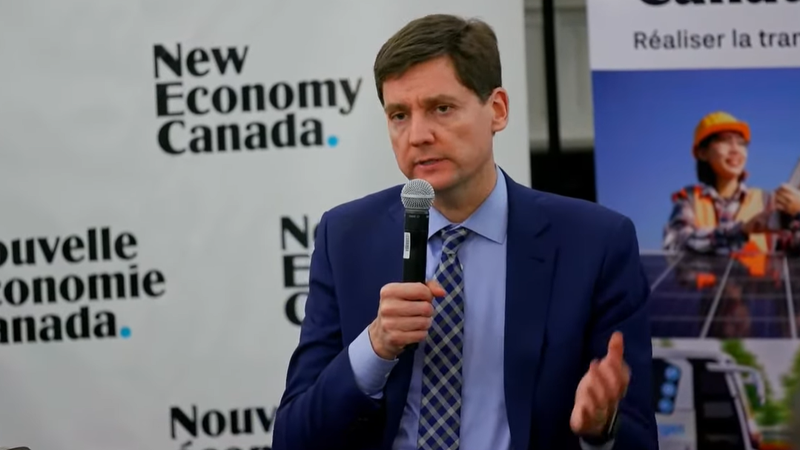
Premier David Eby speaking at the Clean Economy town hall, hosted by New Economy Canada, Thursday, Nov. 23 (photo courtesy of the B.C. Government / Youtube)
Investing in Green Technology

B.C. premier claims climate policies are benefiting the economy

Nov 23, 2023 | 4:30 PM

The Premier of British Columbia said action is being taken to grow the economy while also tackling climate change.

Speaking at a town hall featuring business and industry leaders and hosted by the group New Economy Canada Thursday, Nov. 23, David Eby acknowledged the challenges climate emergencies have created recently.

“We had an unbelievable terrible summer in British Columbia, we had the biggest wildfire season our province has ever seen. We spent more than a billion dollars. The full bill is not in yet in terms of responding to that,” Eby said.

“Before that we had the atmospheric rivers flooding out the Fraser Valley, a one-in-a- hundred, we’re told, year event, that might happen again. Beyond that, we had the heat dome where people died because it got too hot in their homes. And we have the Cowichan River right now that was on life support all summer with mechanical pumps putting water in to make sure fish were able to survive.”

Eby said these and other events, including the pine beetle wintering overnight, all have a monetary and environmental cost, and the province needs to respond with policies to mitigate and reduce the frequency of these incidents.

Eby added the B.C. NDP are the only provincial party with plans to address climate change, pointing to the B.C. United plan that weighs heavily on LNG without any oversight and expecting industries to take it upon themselves to implement their own internal policies such as with carbon capture, and how B.C. Conservative leader John Rustad had just claimed CO2 was not a pollutant and denied climate change was a crisis.

“But it’s important not to get discouraged, because I think British Columbians support strong climate action, and I know that among those British Columbians is the business community,” Eby stated.

“The business community in British Columbia understands that there’s a massive economic opportunity around reducing carbon, around developing leading technologies to respond to the climate crisis, and that they are prepared and ready to invest in our province.”

He pointed to Canada’s first renewable, zero-carbon diesel refinery slated to open in Prince George in the coming months, a green-hydrogen plant proposed for Northern B.C., and the investment to establish the EV-One Moli lithium-ion battery cell plant in Maple Ridge as examples of the province boosting the economy while taking action to combat climate change.

“Our strongest future is the one the rest of the world is going, which is a low carbon future,” Eby said.

“That’s where the jobs are, that’s where the opportunity is, that’s where the growth is. We’ve shown it to-date in our government over the last five years with massive growth in foreign-direct investment, massive growth compared with other provinces in our GDP [Gross Domestic Product], and reducing emissions at the same time.”

During the town hall, Eby spoke on a number of topics brought forward by industry leaders.

It was brought up that, in order to bring new businesses to the province, there needs to be infrastructure in place to provide energy to the facilities. Eby responded by stating having hydro power is one of B.C.’s economic selling points.

“Having a reliable source of firm, clean, zero-emission electricity is a huge advantage for us to attract industries,” Eby said.

“So what you see in our province is where there is infrastructure to an abandoned pulp mill site, for example, that otherwise wouldn’t be desirable, because the infrastructure is already built there companies are coming and want to make proposals for these sites. It leads to the obvious inference that if we build out clean electricity in advance of particular customer demand, whatever industry it may be in the future, that demand looks like it’s going to increasingly show up in our province.”

He did note this interest does create some challenges in terms of existing industries looking to decarbonize and convert to hydro power and the need to build the infrastructure to those sites, which is outside the province’s purview. Eby stated a taskforce has been established to look at how more electic generating and transference infrastructure can be built to serve both the new and the existing businesses converting to hydro without impacting BC Hydro customer rates.

Eby also spoke at length about the forestry, which he called one of the industries hardest hit by climate change, saying it is “devastating” to see, partly because it is part of the province’s climate response plans.

“There’s a couple different components to it, one is that wood products, when they’re used in buildings, are inherently lower carbon than other products like steel, concrete. We’re not going to get rid of steel and concrete, they’re always going to be there, but the more we can use B.C. wood products, we’re creating economic opportunity for British Columbians and reducing carbon,” Eby said, pointing to the province’s mass timber program supporting the industry that not only create jobs but also lead to low-carbon construction.

The premier also noted that the FireSmart B.C. program has been somewhat successful in clearing potential fuel loads, and those materials can then be repurposed for pulp or biomass. He noted the Ministry of Forests was also working on a program to repurpose trees burnt in wildfires for use as pulp or biomass, noting that program would also see saplings planted quickly in those fire-ravaged areas to replace the downed trees and help stabilize the soil.

The province also has an Old Growth Strategy that Eby stated aims at protecting the ancient trees in B.C. that act as a carbon sink, while also ensuring the forestry industry still has access to the needed materials.

Brenda Bailey, Minister of Jobs, Economic Development and Innovation, who was also in attendance at the town hall, added that B.C. has the most buildings made of mass timber per capita than anywhere else in North America, and has become a leader in mass timber export by pointing to how B.C. products are being shipped outside of Canada, specifically noting the local product will be used to build the new Google headquarters in the U.S.

At the town hall, Eby stated the province was working in partnership with First Nations to develop energy generation projects through the $150 million New Relationship Trust.

“One of the things we’ve seen is some Indigenous projects are, on their own, insufficiently economic to be able to take advantage of a big call for power. Some projects are huge, but some aren’t,” Eby stated.

“To ensure equity, ensure opportunity for Indigenous people across the province, this money will help them partner with companies that they can work together with and create economic opportunities, training opportunities, construction opportunities, maintenance opportunities, on their territory to create clean electricity.”

Another initiative being undertaken by the province is ensuring First Nations have the ability to participate economically in large-scale projects, such as the North West Transmission Lines that are connecting mining, oil and gas and other industrial sites to hydro power.

He also said work was ongoing abroad to find more customers, saying new trade promotion offices have opened in Vietnam, Taiwan and the Philippines, building off existing partnerships with other Asian countries like Korea and Japan.

“This can change, as we’ve seen, but in these countries there’s no debate. In Japan, it is so clear their plan to decarbonize and their look for technology and their look for resources. In Korea, it is so clear that this is where they’re going around decarbonation and the need to make sure they’re on the leading edge of that. In Singapore, massive government programs to build up renewable fuels — we visited a massive, a huge renewable fuel refinery in Singapore directly supported by government — because that is where they’re going,” Eby explained.

“So finding those countries that are heading in that direction, that are looking for the products, the services and the resources that we have here in British Columbia and promoting that has been a core part of our government’s work and we’re going to keep doing that.”

Bailey added that B.C. is an export economy, pointing to how exports have increased by 50 per cent since 2017 levels, and having these government connections means B.C. companies have access to more connections with delivering their green products to international markets.

Eby added the climate crisis cannot be ignored, and doing so will have a negative impact on the province’s economy, stating the work by the B.C. NDP is not only tackling climate change but also ensuring British Columbians have sustainable jobs.

“B.C. can’t afford, because of the forest fires we’ve seen and the floods, to abandon our fight on climate change,” the premier stated.

“Economically, we can’t afford to miss this train that’s going. We’ve got to be on board and we’re already seeing the results.”

View Comments