
Get the Top, Local stories delivered to your inbox! Click here to join the daily Vernon Matters newsletter.
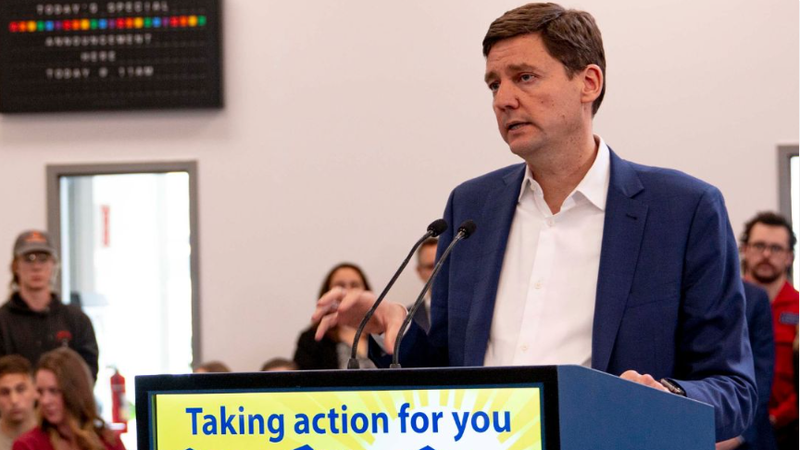
Premier David Eby announcing the new Wildfire Training and Education Centre at Thompson Rivers University in Kamloops. (photo courtesy of TRU/Instagram)
'first-of-its-kind'

New wildfire training and education centre announced

Apr 4, 2024 | 2:42 PM

Thompson Rivers University in Kamloops will offer a range of wildfire and emergency preparedness courses in the future, while the province is taking steps to reduce the impact of future wildfires.

The province announced Thursday, April 4, that a dedicated Wildfire Training and Education Centre would be opening at the university.

“This centre will offer everything from basic training, all the way through to post-doctoral work on fire behaviour and science, so that we have the full range of expertise right here in British Columbia,” Premier David Eby said.

“This will be a first-of-its-kind centre in North America where people can earn credits for this kind of educational work and this training towards an undergraduate degree. This training institute will also be very practical, there will be a partnership between TRU and the B.C. Wildfire Service to ensure the education is as applicable as possible to the realities we face here in British Columbia.”

The program will be designed in 2024, with courses set to launch as early as 2025.

The new wildfire centre was the flagship recommendation made by the Premier’s Task Force on Emergencies, which was formed in 2023 following the two worst wildfire seasons in B.C.’s history.

“The recommendation was that we really need to up our game in our training and our opportunities for people to deepen their knowledge and their skills, to build out the leadership in wildfire fighting teams we have here in the province,” Eby explained.

The new centre is expected to help bolster the firefighting ranks, and also help B.C. lead the way with research into forest fires.

“Through the new centre, we will take action to grow our local contingent of wildfire fighters, provide them with cutting-edge science and technology, and support their long-term career development here in British Columbia,” Minister of Forests Bruce Ralston said.

“From hands-on-basic training in the field to the development of diploma and academic degrees, the new centre, here at Thompson Rivers University, will be an educational destination for people from British Columbia, nationally, and, indeed, from around the world.”

Ralston noted the B.C. Wildfire Service’s existing training programs would be incorporated into the curriculum of the new centre, stating, “by 2028-29, over 1,000 workshops will be offered every year, which will translate into 10,000 course registrations,” adding people taking these courses will be able to transfer their credits into academic programs offered at TRU, including Wildfire and Climate Science, Behavioural Science, Predictive Technologies, Forest Ecology, Fire Weather, and First Nations History and Cultural Fire.

It was noted TRU was selected as the institute to house this new centre as the school and province had previously invested in wildfire related education.

Through the partnership between TRU and the province, an Innovation Research Chair in Predictive Services, Emergency Management and Fire Science was brought in in 2022. The following year, the school established the Institute for Wildfire Science Adaptation and Resiliency, allowing for research into wildfire solutions at the university.

“We are working in partnership with the province, using our strengths as a university in research, teaching, curriculum development, and innovation, to improve how, as a society, we adapt to living with wildfire,” Brett Fairbairn, president and vice-chancellor of TRU, said.

“Our concept here at TRU is one of research-informed training, education and innovation, as the premier has said, from basic skills to post-doctoral research. We are well prepared for this task: we’re a research university, we also offer non-degree credit training, we have a history rooted in the Interior, we engage with the Secwépemc as well as other First Nations and with Métis and small communities who face fire risk on the land.”

The task force, made up of more than 60 emergency management specialists, First Nations, and other key partners, worked together for six months to compile a list of 30 recommendations.

“There were a number of recommendations that enabled us to take action right away,” Eby noted.

“Some of these recommendations that are already underway include increasing the use of new technology, including AI (artificial intelligence), to predict fire behaviour and to be able to ensure we are keeping people safe; better support for evacuees; ensuring that there’s training available for emergency support workers that is streamlined so that there is more local support workers that are available and people are better supported when they’re evacuated; enhancements to firefighter recruitment to make sure we have the team that we need going into the forest fire season; and boosting our firefighting fleet and equipment, the technology that’s available to fight across a broad variety of terrains and, hopefully, including firefighting at night, despite the dangers that that can present.”

It was noted the action involving recruitment has been successful so far.

“We strengthened recruitment this year, leading to nearly 2,000 applicants, double the number we had the previous year. We also enhanced recruitment from rural, remote and First Nations communities, providing us with more opportunities to take local knowledge and networks and use it to fight the fires,” Ralston stated.

“And now [with the new centre], we’re taking a major step to strengthen our capacity to train wildland firefighters and support their long term development and careers.”

The full list of recommendations can be found here.

The cost for the new centre at TRU was not known, as the province is still going through the design and tendering process for the new building.

The costs associated with the other recommendations had already been included in Budget 2024, with Eby stating it should help ease the financial pressure of additional spending during the wildfire season, noting response to the 2023 fires cost roughly $1-billion.

View Comments