Get the Top, Local stories delivered to your inbox! Click here to join the daily Vernon Matters newsletter.
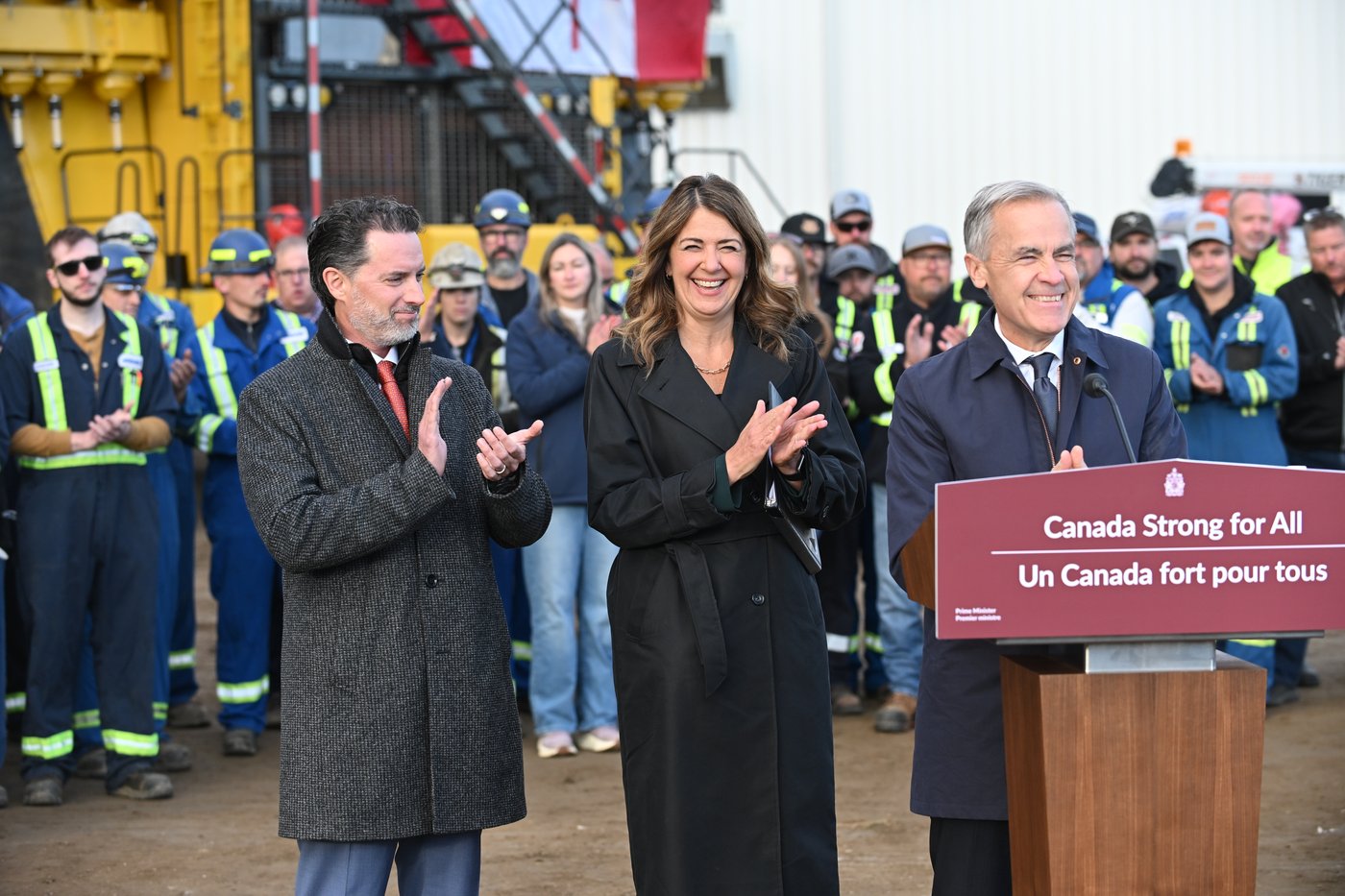
From left, Scott Burrows, CEO of the Pembina Pipeline Corp, Alberta Premier Danielle Smith and Prime Minister Mark Carney applauded after speaking in Fort McMurray on Thursday Oct. 1, 2026. Prime Minister Mark Carney declared the Pacific Link pipeline project to be in the national interest. THE CANADIAN PRESS/Greg Halinda

Carney expresses confidence in producer demand for new West Coast oil pipeline

Oct 1, 2026 | 12:27 PM

CALGARY — Prime Minister Mark Carney expressed confidence Thursday that oilsands producers will be keen to spend on expansion projects to fill the proposed Pacific Link pipeline, which has been deemed Canada’s first project of national interest.

“These are commercial decisions that the companies will make,” he told a news conference in the oilsands epicentre of Fort McMurray, Alta.

But Carney said Pacific Link would be a “tremendous opportunity for them,” given the additional access it would provide to Asian markets willing to pay a higher price for Canadian crude. The narrowing of the price gap between the heavy crude produced in Alberta and light, globally traded crude would narrow, amounting to a $6-billion annual boost to industry, he said.

He highlighted other measures his government has taken to instil investor confidence. One is a streamlining of the regulatory review process that means “doing the work once and getting to the right answer on time,” where previously, projects would linger in limbo for several years. Another measure he cited is a major expansion to business tax incentives announced recently that mean companies can quickly recoup costs on a broader array of investments.


Carney also noted the five biggest oilsands producers are together planning to build the Pathways carbon storage project in Alberta — a condition for the pipeline moving forward, and vice versa.

The Alberta government submitted its application for the million-barrel-per-day pipeline in July to the major projects office, which Ottawa established last year to speed along infrastructure deemed in Canada’s national interest. Its cost has been estimated at $35.2 billion to $43.7 billion. The Alberta and federal governments evenly split 90 per cent of the project, with Pembina Pipeline Corp. holding the rest.

The line would run from Bruderheim, Alta., to a marine export terminal planned for Delta, B.C.

Producers have the financial wherewithal to fund “a significant share” of the growth that would be needed to fill the pipeline, said an explanatory note accompanying the cabinet order designating the pipeline a national-interest project.

Demand on the other end of the pipeline in the Asia Pacific region is also expected to be “resilient,” it said.

“Markets such as China, India, South Korea, and Japan continue to seek reliable heavy crude supplies. Interest from potential buyers and support from government partners also suggest meaningful demand exists,” it said.

Long-term contracts will be needed to ensure certainty in the years to come. In the spring, the project partners aim to hold an “open season” — a formal process to solicit bids from customers for service, and allocate space on the pipeline accordingly.

Lance Mortlock, managing partner at EY Canada, said there’s a “chicken and egg” scenario when it comes to building the massive new pipeline while growing the oilsands production that would fill it long-term.

Producers have in recent years shied away from big-ticket investments, in part due to a shortage of pipeline infrastructure to bring their oil to market.

“My sense is they’ve been waiting to see if some of the conditions start to change,” Mortlock said.

Industry has welcomed Ottawa’s moves to simplify the regulatory process, roll back Trudeau-era environmental policies and beef up tax incentives for new investments. Smaller scale, shorter-term pipeline expansion projects are now in the works heading to the U.S. and West Coast.

“We will start to see the companies develop big capital projects again. Do I think that we’re going to see the mega mines that we saw 10 years ago? Probably not. But do I think we’re going to see 150,000, 200,000-barrel-a-day in situ expansion? Yeah, for sure,” Mortlock said, referring to steam-driven operations with a smaller footprint.

“And now the work is beginning at some of these oilsands companies to say, ‘Well, what does that look like? What kind of assets would we develop? How big would we develop them? What’s the sequencing of those assets?’”

Environmental advocates, meanwhile, decried Ottawa’s financial stake in a fossil fuel project at a time when many countries are looking to shore up their energy security with renewables and electrification while reducing their own climate-warming emissions.

“A reckless waste of Canadians’ money” was the assessment from Environmental Defence.

“Even with a rushed rubber-stamp review, this pipeline could not be in service until well beyond the peak of global oil demand. No new buyers will emerge for more Canadian oil,” said Emilia Belliveau, the group’s energy transition program manager.

“An honest financial assessment would also consider that this pipeline will fuel further climate change, which is already costing Canada billions of dollars a year — in flooded basements, evacuated towns, and wildfire smoke that shuts in entire cities. This is a bad investment dressed up as a national priority.”

Stand.earth called it “the money pit pipeline” and the Pembina Institute dubbed it an “expensive gamble on a single export product with a doubtful future.” The Pembina Institute has no affiliation with Pembina Pipeline.

“Canadians should closely examine why the private sector has refused to invest in this high-risk, high-cost project,” said Janetta McKenzie, who directs the Pembina Institute’s oil and gas program.

“The weakening outlook for global oil demand has made the business case for this project impossible to sell to shareholders.”

This report by The Canadian Press was first published Oct. 1, 2026.

Companies in this story: (TSX:PPL)

Lauren Krugel, The Canadian Press