
$19.4 million in new tourism related projects
-
Share on Facebook
-
Share on Bluesky
-
Share on X
- Copy Link
Six tourism dependent communities it the Thompson-Okanagan tourism region have received almost $2.8 million from the provincial government to support tourism infrastructure development.
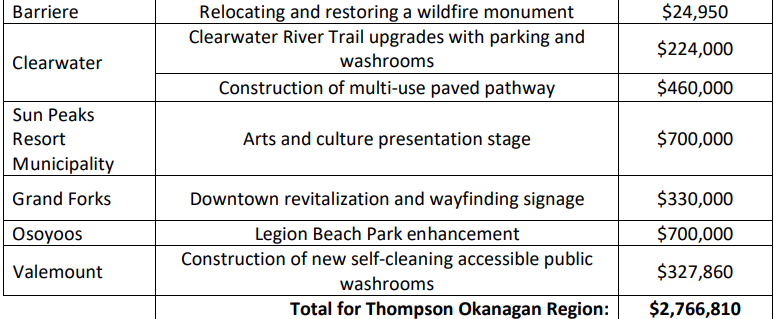 Thompson-Okanagan projects (Photo/Province of B.C.)
“We’re investing to make our region even more attractive to visitors. New funding for tourism-dependent communities in our region means new jobs in our communities and new ways to showcase all that we have in our backyard,” Roly Russell, MLA for Boundary-Similkameen said . “When we’re ready to welcome people back, I look forward to enjoying the new arts and culture stage at Sun Peaks and exploring the amenity upgrades in Barriere, Clearwater, Grand Forks, Osoyoos and Valemount.”
A total of 46 new tourism-development projects were identified by communities throughout B.C. and include updated trails for e-bikes and adaptive trikes, signage, solar electric-vehicle charging stations, sea kayak touring and picnic facilities, water park construction, and creating an arts and culture stage.


