Get the Top, Local stories delivered to your inbox! Click here to join the daily Vernon Matters newsletter.
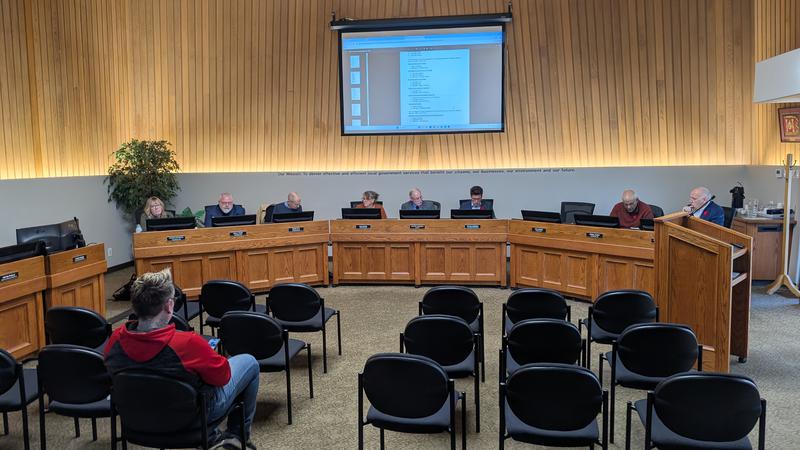
Vernon City Council at the regular meeting Monday, Nov. 10 (photo by Liam Verster / Vernon Matters)
Opposition to Proposed Legislation

Vernon, UBCM oppose bill to automatically approve permits

Nov 12, 2025 | 4:18 PM

Vernon is joining a call opposing efforts to cut red tape on developments, saying it undermines the authority of local governments.

The Union of B.C. Municipalities (UBCM) has issued a letter opposing the proposed private members bill by George Anderson, MLA for Nanaimo-Lantzville and Parliamentary Secretary for Transit.

The UBCM said the bill, entitled the Professional Reliance Act, would require that local governments must accept, as meeting permit or bylaw requirements, any submissions certified by a professional engineer, architect, agrologist, applied science technologist or technician, biologist, or forest professional, as long as the submission is complete and has been made without any complaint to the superintendent.

The UBCM also stated in the letter that the legislation would provide “the Lieutenant Governor in Council with regulation-making authority to: designate a local body as a local government for the purposes of the Act, establish dispute resolution procedures, and notably, to set timelines for development application processing.”

The union stated the bill was brought forward without consultation, and declared that the act seemed to indicate a “[continued] trend towards sweeping, centralized legislation that impacts local governments,” as it would come following other regulations that have taken power away from local government through housing targets; bills aimed at addressing small-scale multi-unit housing and transit oriented areas; the revised development finance framework, and the Infrastructure Projects Act that provided the province with regulatory override powers for major capital projects.

“The rapid pace of legislative change continues to risk overwhelming local governments’ ability to adapt and to respond to urgent priorities,” the UBCM letter stated.

“Furthermore, because local governments are the order of government closest to citizens, they are uniquely suited to represent local interests. When powers are shifted away from local governments, it disempowers those who elected them.”

Vernon City Council received the letter at the regular meeting Monday, Nov. 10, where local elected officials raised their own concerns about the proposed legislation.

Councillor Brian Guy said he felt there were a number of problems with the bill.

“This bill erodes the local government’s ability to do these things, to protect public health and safety and the environment, it erodes our ability to do that,” Guy stated after receiving the letter during Monday’s meeting.

“Plus, the author who wrote this bill does not seem to understand the Local Governance Act, and is inconsistent in several ways. I won’t go into it but there’s a bunch of inconsistencies that don’t match up with the legislation.”

The Mayor of Vernon agreed that the proposed bill would not benefit municipalities or the public.

“My biggest concern with this private members bill is that it means certified professional writes a report, then we as the city can’t question that report because they’ve put their professional stamp on it,” Mayor Victor Cumming said Monday.

“In the seven years that I’ve been here [as mayor], sometimes those professional reports are inadequate or take a slant on a particular piece of advice, and some of those professionals are no longer in the profession. That takes substantial time to go from a poorly written report or a poorly provided opinion, and I think our staff has to have the ability to question those, because to go through the standards process that they recommend means that its about the individual instead of the content of the recommendation, and in the meantime things could proceed because that’s the recommendation. We would not be in a position to question that recommendation without going through this whole external process where we carry the liability.

“If a sewer pipe is in the wrong place, that’s a cost to us. If there’s a problem with the drinking water, it’s a problem for us, not a problem for the design engineer. So I find this really surprising that we wouldn’t give our staff the ability to question professional reports and, in some cases, get reviews from other professionals when [a project] is particularly complex or it’s particularly surprising, the recommendation that comes forward. I think this is just good due diligence on the part of local government.”

The mayor added that there have been only a handful of instances in the past where a report was questioned and had to be reviewed by staff or an external agency that resulted in the proposal seeing major changes, but added it was “our responsibility and therefore we need the authority to question what’s put in front of us.”

Guy added that the complaint process would take time and would not be “suited to efficient resolution of issues that, if left unaddressed at the design stage, could lock in significant risks to the public.” He also stated he believed this legislation could lead to more poor quality work being done, which in turn could lead to erosion of public trust.

Speaking with Vernon Matters following Monday’s meeting, the mayor reaffirmed his position on the matter in regards to its impact on reviewing reports.

“The private members bill basically would, in most cases, lock us in to whatever professional advice comes forward, rubber stamp it, usually from developers who have their own staff who put things forward,” Mayor Cumming said.

“Sometimes what they put forward, we think, is not valid, and currently what we can do is go and get other professionals to give us a review of what has been put in place in front of us, and they want to remove that, and I think that is a poor recommendation.

“We’ve had incidents in the seven years that I’ve been in the [mayor’s] chair when, definitely, an external review was important, and there was definitely a different result after we had the external review. I think that’s a critical step that we have in local government.”

He also clarified this legislation would mean projects get automatic approval unless the municipality files an official complaint, in which case it would go to a thrid party for review. However, he stated the local governments can already order their own reviews under the current laws if needed, and stating that “we think that’s where it should stay.”

Council voted in favour of having the mayor write letters to the provincial government opposing the proposed legislation.

Council also authorized the mayor to co-sign any letters put forward by neighbouring municipalities that have similar opposition to the bill.

View Comments