
Get the Top, Local stories delivered to your inbox! Click here to join the daily Vernon Matters newsletter.
Stock photo (ID 36442018 © Phasinphoto | Dreamstime.com)
Labour Statistics

Unemployment rase rose in local economic region

Apr 5, 2024 | 11:04 AM

The economic region that includes Vernon and the North Okanagan saw unemployment rise and employment decline last month.

Data from Statistics Canada showed the Thompson-Okanagan had an unadjusted unemployment rate of 6.7 per cent in March, and employment rate of 53.5.

The most recent unemployment rate was up from February’s figure of 6.0, and was two points above the rate of 4.7 per cent recorded in March of 2023.

Employment declined on a monthly and annual basis, falling slightly from the rate of 53.6 per cent in February, but down nearly four points from the rate of 57.4 per cent the previous March.

StatsCan did not provide data specific for the City of Vernon, but did have adjusted, three-month moving average rates for Kelowna.

The data collection agency reported Kelowna’s unemployment rate was 5.4 per cent in March of 2024, while the employment rate was 56.9.

Unemployment was down from the rate of 5.5 per cent recorded in both February of 2024 and March of 2023.

Employment saw a similar trend, rising to 56.9 per cent from the rate of 56.6 recorded both the previous month and in the same month the year prior.

Provincially, the adjusted unemployment rate was recorded at 5.5 per cent, while the employment rate was 61.7 per cent this past March.

Unemployment was up in B.C., rising from the rate of 5.2 per cent in February and up nearly a full point from the 4.6 per cent recorded in March of 2023.

B.C.’s employment rate was unchanged on a monthly basis, though was down from the rate of 61.9 per cent recorded a year before.

“In the face of high interest rates and slower global economic growth, B.C. held steady in March with a growth of 6,600 jobs and a gain of 75,000 jobs since March 2023,” Brenda Baily, Minister of Jobs, Economic Development and Innovation, stated.

“B.C. and Ontario were the only provinces with job gains in March. B.C.’s unemployment rate is 5.5%, the fourth-lowest among provinces and below the national average. At $36.50, we have the highest hourly wage among provinces.”

Bailey noted B.C. also saw increases in the health care and social assistance sectors last month, adding the province was working towards addressing labour shortages by making it easier for people to access skills training programs and complete their apprenticeships.

As of the end of March, B.C. had the fourth lowest unemployment rate of all the provinces, and was sixth when territories were included and territories.

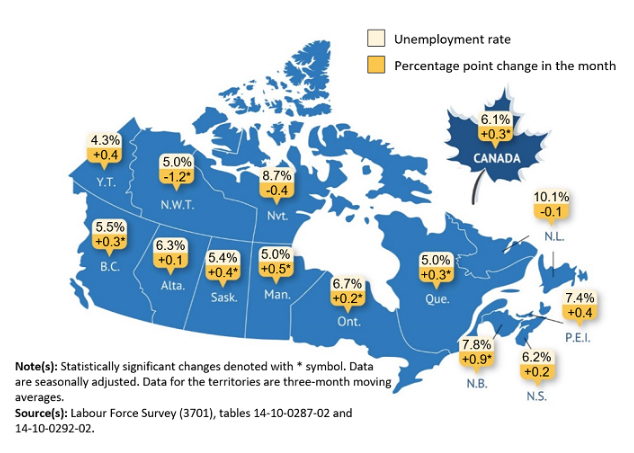
Yukon had the lowest rate in Canada at 4.3 per cent, followed by 5.0 per cent recorded in Quebec, Manitoba and the North West Territories, while Saskatchewan had a rate of 5.4 per cent. All those regions, with the exception of NWT, saw unemployment increase on a monthly basis March.

March’s adjusted unemployment rates (image courtesy of Statistics Canada)

Nationally, the adjusted unemployment rate was 6.1 per cent.

That was up from the previous month’s rate of 5.8, and was more than point above the 5.1 per cent rate recorded in March of 2023.

StatsCan stated employment in accommodation and food services, wholesale and retail trade, and professional, scientific and technical services declined across Canada in March, though did add there were increases in health care, social assistance.

The data collection agency stated March was also the sixth consecutive month where the national employment rate fell on a month-over-month basis.

It was noted the most recent decline was mainly driven by the employment rate for 15 to 24 year olds falling to 55 per cent, which was the lowest level on record for that demographic since February of 2012, with the exception of 2020 and 2021 during the COVID-19 pandemic.

View Comments