
Get the Top, Local stories delivered to your inbox! Click here to join the daily Vernon Matters newsletter.
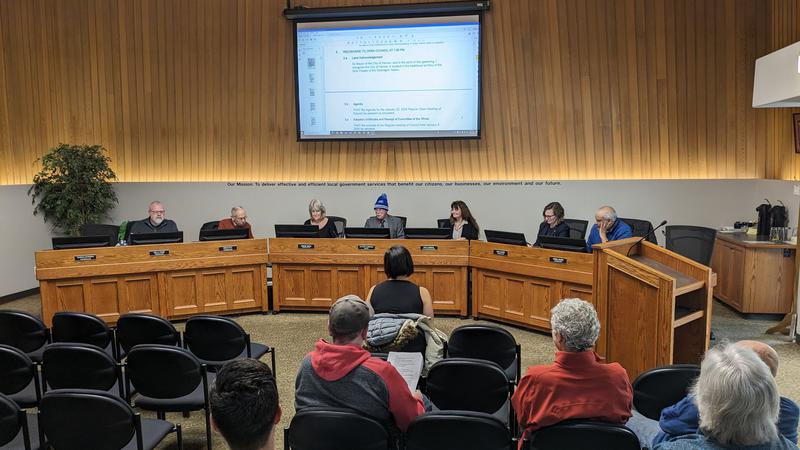
Vernon council's regular meeting Monday, Jan. 22 (photo by Liam Verster / Vernon Matters)
Housing Density Legislation

Housing legislation trying to solve problems not faced in Vernon: mayor

Jan 23, 2024 | 5:00 AM

Vernon’s mayor and council continue to have issues with new provincial housing legislation which they say doesn’t apply to the city.

At the regular meeting Monday, Jan. 22, city council was presented with a review of legislative changes and the impacts on zoning that Bills 44 and 47 would have on Vernon.

Bill 44 requires the local governments change their zoning bylaws to permit more multi-unit dwellings built on properties, while Bill 47 outlines Transit Oriented Areas (TOA) and requires higher density developments within certain distances of transit hubs.

Bill 44 requirements:

  • A baseline density of one secondary suite and/or additional dwelling unit permitted on a property with a single-family home or duplex
  • Minimum three units on each parcel of land 280m2 or less in area
  • Minimum of four units per parcel of land greater than 280m2
  • Minimum six units per parcel of land greater than 280m2 and within 400m of a prescribed transit stop that sees a bus visit every 15 minutes

There were some exemptions to the requirements in Bill 44, such as conditions identified to be hazardous, land subject to existing heritage revitalization agreements, properties not connected to a water and a sewer system, properties where the minimal parcel size is 4,050m2.

Bill 47 requirements:

  • Multi-unit developments of up to a minimum of 10 allowable storeys within a minim allowable density of 3.5 Floor Area Ratio (building area divided by lot area) less than 200 metres from a transit hub
  • Multi-unit developments of up to a minimum of six allowable storeys within a minim allowable density of 2.5 Floor Area Ratio between 200 and 400 metres from a transit hub

Under Bill 47, municipal governments are not permitted to regulate how many residential parking spaces can be developed in the TAO, though it was noted the developer could choose to build as many spaces as they wish.

The report stated that, as per the bills that were both passed in November, a new zoning bylaw or amendments that meet the provincial legislation must be adopted and implemented by June 30, 2024, and a housing needs report must be compiled with a draft version of it included in a new Official Community Plan (OCP) by Dec. 31, 2025. The OCP must include a five- and a 20-year forecast.

Council was presented with the report and tasked with directing administration to prepare new zoning bylaws to reflect the legislative requirements, and to prepare a policy detailing how in-stream applications would be managed during the transition period.

During the meeting, several members of council had issues with the regulatory changes.

Councillor Brian Guy noted many of the minimum density regulations required in Bill 44 were already met through existing city bylaws.

Matt Faucher, a planner with the City of Vernon, responded to Guy’s comment by stating the baseline density of permitting a minimum of one secondary suite and/or one accessory dwelling unit on properties with single family homes or duplexes is permitted, though work would be needed to be done to rezone the properties to allow for additional units.

Councillor Kari Gares expressed concern with the parking requirements in the TOA, as there was a possibility that a developer could build housing but not include enough parking spaces as there would be no municipal regulations to follow. She also had concern with over-developing in areas not currently served by public transit.

Mayor Victor Cumming said Vernon said this appeared to be a blanket approach to housing requirements that did not take into account the individual needs of municipalities.

Speaking with Vernon Matters following the meeting, Cumming re-iterated the idea that the legislation aims to find solutions to problems Vernon does not face.

“Some of the things they’re suggesting, [such as] allowing second and third dwellings on a site, we’ve been ahead of that, so that, for us, has very little impact. In lots of communities that’s a very major conversation, some of them right here in the North Okanagan, but, for us, we have gone through that long before the legislation,” Cumming said, though said the rest of the provincial policies were not meeting Vernon’s needs.

“There’s a couple of pieces that are really, in council’s view, are really designed where it’s a Greater Vancouver issue, it’s [an issue for] the dense communities in the Capital Regional District (Greater Victoria). We totally understand why those are issues there, they’re just not issues for us here.

“So we’ve ended up with a solution where we don’t even have a problem, so it means we’ve got to walk through a number of processes and adjust many things within our systems, big impact on our staff over the next six months, our planning and engineering staff, to solve something that’s not a problem.”

Cumming added the TOA regulations also do not meet Vernon’s needs, as the Village Green Mall and surrounding commercial area were not suitable for housing development, adding the downtown exchange already has zoning in place similar to the provincial regulations but noted the area is not sought after by developers looking to build housing.

Council voted in favour of the recommendations. Councillors Teresa Durning and Brian Quiring were not in attendance for the meeting.

Cumming had been in contact with Housing Minister Ravi Kahlon regarding the short term rental regulations the province was bringing in, so he and council agreed to continue with that open line of communication and bring forward the issues in Bills 44 and 47, as well as those with the expansion of the Speculation and Vacancy Tax, for further discussion.

“I’ll be penning a letter quite quickly to him and I’ll be requesting a face-to-face [meeting] because it just seems like, and when we read their guidelines, all their examples are Victoria or Vancouver, so that says to me that may reflect the situation there,” Cumming told Vernon Matters.

“But I know in our situation here, it doesn’t reflect the situation.”

View Comments